
The Complete Guide to Real Estate Growth Systems
How Modern Agents Build Predictable Businesses in 2026
A research-backed guide to lead conversion, client experience, CRM architecture, automation, AI, operational intelligence, and the systems that make growth more repeatable.
Research updated: August 20, 2026 | Approx. 30-minute read | Category: Real Estate Systems, AI & Automation, Business Growth
EDITORIAL NOTE
This guide separates verified research from strategic interpretation. The 2026 data points are sourced from NAR, Zillow, RPR, McKinsey and Harvard Business Review. The section looking toward 2037 is a scenario-based strategic outlook, not a prediction or guarantee.
1. The Growth Paradox: More Opportunity, Less Predictability
A modern real estate business can look healthy long before it feels healthy. The agent may have a polished brand, a growing database, active advertising, a steady content calendar and several software subscriptions. New inquiries arrive from listing portals, paid campaigns, referrals, open houses, social media and search. The calendar is busier than it used to be. Yet revenue still arrives unevenly, follow-up still depends on personal attention, and the owner can leave the office for a day only to return to a pile of messages that now feel older than they should.
That tension is not unusual. It is a consequence of an industry that has become dramatically better at creating digital activity without always becoming equally good at managing it. The internet expanded access to listings. Portals made property discovery continuous. Social platforms gave individual agents their own media channels. CRMs made it possible to hold thousands of contacts. Advertising platforms made lead volume scalable. Now AI can draft, summarize, classify and in some cases act inside workflows. Each layer increased capacity, but capacity without operating discipline can become complexity.
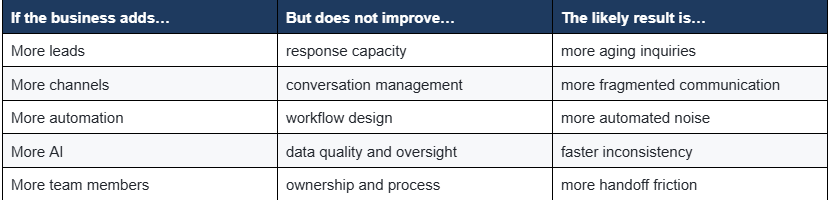
The important distinction is between activity and throughput. Activity is the amount of motion around the business: clicks, inquiries, conversations, tasks, campaigns and appointments. Throughput is the proportion of that motion that reliably advances to a useful next stage. A business can increase activity while throughput falls. When that happens, growth feels slower even though the top of the funnel is larger.
The strongest real estate operators therefore ask a different question from the one that dominated much of the lead-generation era. Instead of asking only how to create more inquiries, they ask what happens to every inquiry after it appears. Who responds? How quickly? Through which channel? What information is captured? What is the next logical step? What happens if the prospect is interested but not ready? What happens if the agent is showing a property, driving, negotiating an offer or asleep? Those are not marketing questions. They are operating-system questions.
A simple way to think about the problem is this:
2. What a Real Estate Growth System Actually Is
A real estate growth system is not a CRM subscription, a funnel, an ad campaign or an AI assistant. It is the connected architecture that decides how opportunity moves through the business. Technology is part of that architecture, but so are positioning, process, responsibility, client experience and measurement.
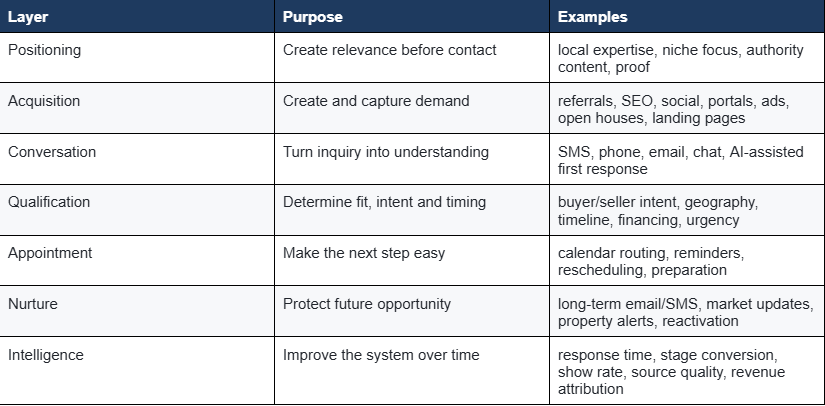
At its simplest, a growth system converts attention into an organized sequence of decisions. A person discovers the agent. The business gives that person a clear way to express interest. The inquiry is captured with useful context. A response happens through an appropriate channel. Qualification establishes intent and timing. The right next step is offered. Follow-up continues when the consumer is not ready immediately. Appointments are confirmed. Outcomes are recorded. Past clients remain part of the relationship system rather than disappearing into an archive.
The reason this matters is that real estate is not an impulse-purchase category. Housing decisions are financially significant, emotionally charged and often delayed by affordability, financing, inventory, life events or uncertainty. A lead that does not transact this week may still represent real future value. A system therefore needs both speed and patience: speed when interest is active, and patience when timing is not yet aligned.
Layer
CORE PRINCIPLE
A tool performs a function. A system defines what should happen, when it should happen, who or what should do it, and how the result becomes visible.
3. The 2026 Data Snapshot: How Buyers, Sellers and Agents Are Changing
The case for better operating systems is stronger when viewed against current consumer and technology behavior. The housing market is not becoming less relationship-driven; it is becoming more digitally mediated. Consumers use apps, websites, search engines, messaging and now AI earlier in the journey, but they still rely heavily on agents when decisions become consequential.
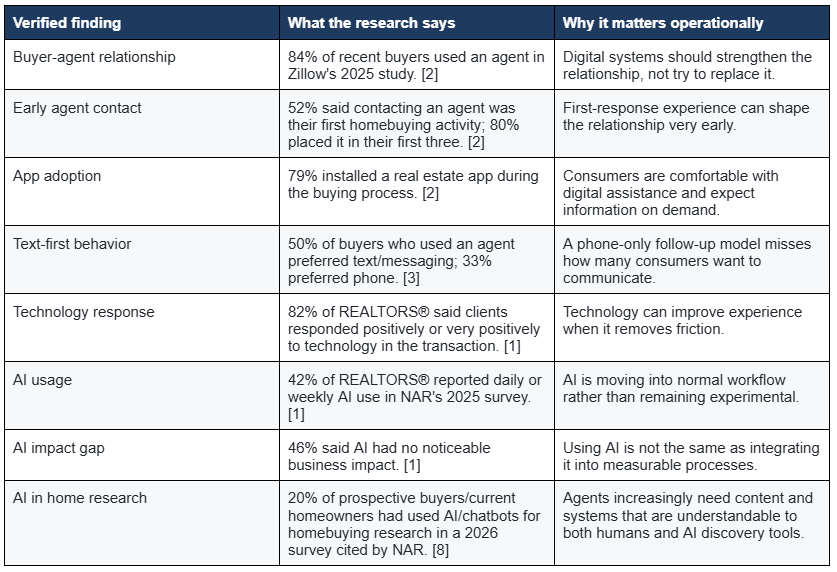
Zillow's 2025 Consumer Housing Trends Report found that 84% of recent buyers used a real estate agent during some part of searching, shopping or purchasing. Fifty-two percent said contacting an agent was their first homebuying activity, and 80% said it was among their first three activities. Seventy-nine percent installed a real estate app during the buying process. [2] In other words, digital discovery and professional guidance are not competing realities; they increasingly coexist in the same journey.
NAR's 2025 Profile of Home Buyers and Sellers arrives at a similar conclusion through a different sample and methodology. It reports that 88% of buyers purchased through an agent or broker and 91% of sellers used an agent. [4] The exact percentages vary because the studies measure different populations, but the strategic message is consistent: technology has changed how relationships begin and how information moves, while the professional relationship remains central.
Communication behavior is changing as well. Zillow reported that 50% of buyers who worked with an agent preferred texting or a messenger app, while 33% preferred phone calls. [3] Prospective-buyer research shows preferences vary by generation, which makes a one-channel operating model increasingly brittle. [11] A modern system should not force every consumer into the same communication behavior; it should make responsiveness and context portable across channels.
The agent side of the market is changing just as quickly. NAR's 2025 Technology Survey found that 20% of REALTORS® used AI daily and 22% weekly. Yet 46% reported no noticeable impact from AI on their business. [1] That gap is one of the most important findings in the current technology cycle. It suggests that access to AI is becoming common faster than operational value is becoming common. The difference between the two is implementation.
4. Why More Leads Can Create Slower Growth
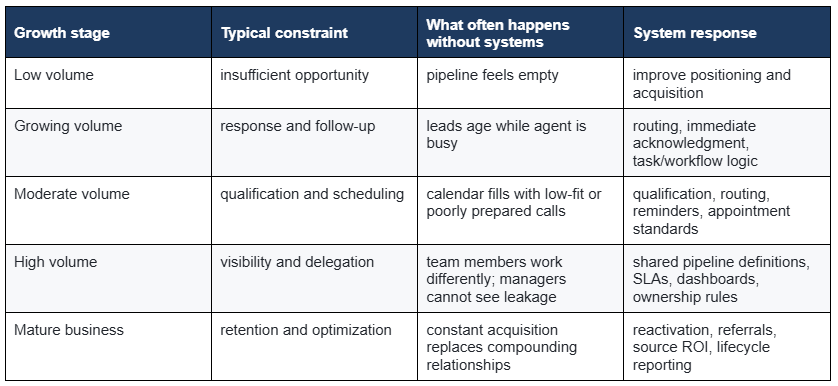
Lead generation remains necessary, but it is only one constraint in a larger system. When a business is small, the owner can compensate for weak processes with personal attention. Ten active opportunities can live in memory. Fifty require discipline. Hundreds require architecture. This is why a business may feel efficient at one level of demand and chaotic at the next without changing anything about the quality of its marketing.
The bottleneck moves. Early in a business, the bottleneck may be awareness. Later, it may be response speed, qualification, appointment capacity, transaction management or nurture. Continuing to push more volume into the top of the funnel after the bottleneck has moved does not solve the constraint. It increases the pressure around it.
This is a systems principle rather than a real-estate-specific one: throughput is limited by the weakest stage in the chain. If the business can generate 300 inquiries but reliably manage only 120, the other 180 are not simply 'extra leads.' They are service risk, reputation risk and wasted acquisition cost. A mature operator therefore treats lead volume as a capacity decision, not merely a marketing decision.
The same logic applies to teams. Hiring another agent without clarifying lead ownership, follow-up standards, handoff rules, pipeline definitions and reporting may add capacity on paper while reducing consistency in practice. Scale is not multiplication of activity. It is multiplication of a process that already works.
Gr
5. The Follow-Up Gap and the Economics of Response
Follow-up is where a surprising amount of marketing value is either protected or lost. The first response matters because a consumer who has just taken an action is in a moment of attention. The later nurture matters because real estate decisions often unfold over months rather than minutes. A good operating system is designed for both moments.
One of the most frequently cited studies on lead response remains Harvard Business Review's 2011 'The Short Life of Online Sales Leads.' The researchers audited 2,241 U.S. companies and separately examined 1.25 million sales leads across B2C and B2B organizations. Companies that attempted to contact a lead within an hour were nearly seven times as likely to qualify the lead as those that waited even an hour longer, and more than 60 times as likely as those that waited 24 hours or more. The audit also found that 23% of companies never responded at all. [5]
That research is valuable, but it should be used carefully. It is not a 2026 real-estate-specific closing study, and 'qualified' meant achieving a meaningful conversation, not completing a transaction. The correct lesson is not that every real estate inquiry must be called within a rigid number of seconds. The lesson is that digital intent decays and that businesses should design response processes around consumer attention rather than internal convenience.
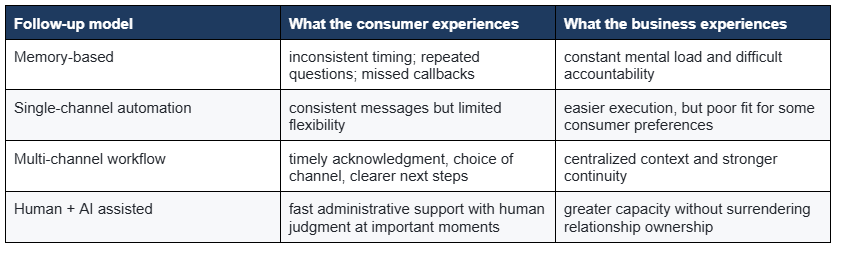
Current real estate behavior strengthens that interpretation. When half of agent-assisted buyers prefer texting or messaging and a large share of home shoppers begin online, the response system needs to meet the consumer where the relationship is already happening. [2][3] An acknowledgment can be immediate while the deeper human conversation happens when appropriate. An AI assistant can collect basic context while an agent is in a showing. A missed-call text can reopen a conversation. A nurture sequence can keep a six-month buyer warm without pretending that every message should be automated.
The operational objective is continuity. A lead should not have to restart the relationship every time the channel changes, and the agent should not have to reconstruct the entire history from scattered inboxes. The system should carry context forward.
RESEARCH CAUTION
The HBR response-time study is strong evidence that online intent can decay quickly, but it is older and not real-estate-specific. Treat it as a design principle for responsiveness, not as a promise of transaction conversion.
6. CRM Versus Operating System: The Distinction That Matters
The term CRM is often used as if it describes the entire business infrastructure. It does not. Customer relationship management software is an important foundation because it stores contacts, activity and pipeline information. But a database becomes operational only when the business has defined what the information means and what actions it should trigger.
A contact record does not create follow-up. A pipeline stage does not create a standard. An automation does not create strategy. The operating system is the layer that connects these pieces: the definitions, rules, workflows, responsibilities, service standards and reporting logic that turn stored information into coordinated action.
This distinction also explains why businesses can own sophisticated CRMs and still feel disorganized. The software may be capable of doing far more than the team has designed it to do. Fields are inconsistent. Stages mean different things to different people. Contacts enter without source attribution. Automations overlap. No one knows which dashboard is authoritative. Technology exists, but operating clarity does not.
A useful way to evaluate any CRM is therefore not to ask how many features it has. Ask whether the business can answer five questions without hesitation: Where did this opportunity come from? What does this contact need? What has already happened? What should happen next? Who or what is responsible for making that happen? If the system cannot make those answers visible, the business is still carrying too much operational logic in people's heads.
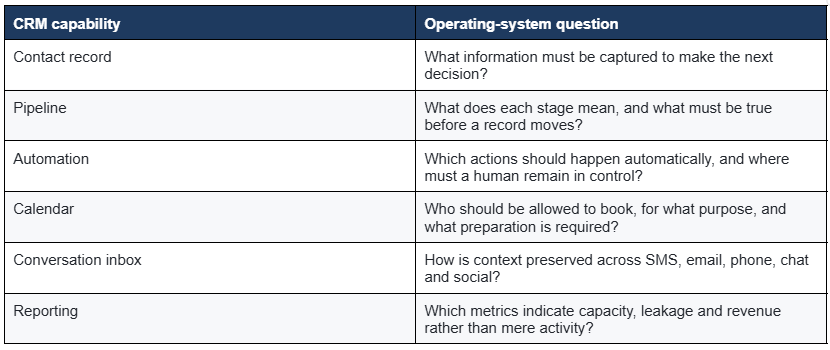
A CRM tells you what is in the database. An operating system tells the business what to do with it.
7. The Modern Real Estate Growth Stack
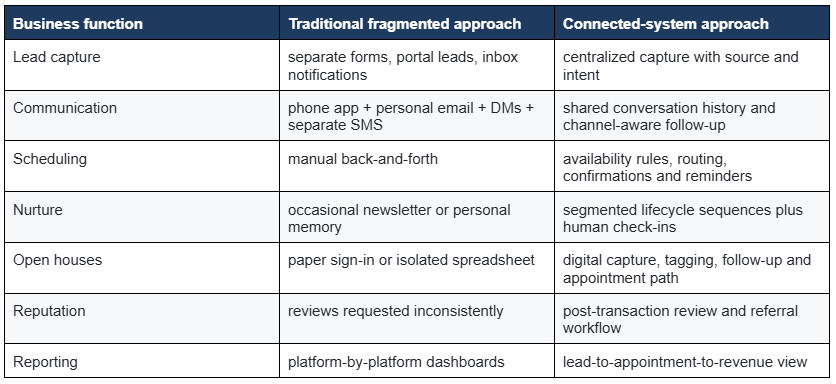
A durable growth system is easiest to understand as a stack rather than a shopping list. The objective is not to own one tool in every category. The objective is to make the layers work together with as little duplication as possible.
At the top of the stack is market presence: the content, reputation, local expertise, referral network, listings and advertising that make the agent discoverable. Underneath that is conversion infrastructure: landing pages, forms, chat, phone, calendar access and clear calls to action. Then comes the relationship layer: CRM records, conversation history, qualification, pipeline stages and long-term nurture. Finally, the intelligence layer measures what the system is producing and where it is leaking.
This architecture helps prevent a common technology mistake: solving every small problem with a new subscription. Each additional tool creates another login, another data model, another integration and another failure point. Sometimes a specialist platform is worth that complexity. Often it is not. The operating question is whether the added capability improves the customer journey enough to justify the added coordination burden.
8. AI in Real Estate: From Tool to Infrastructure
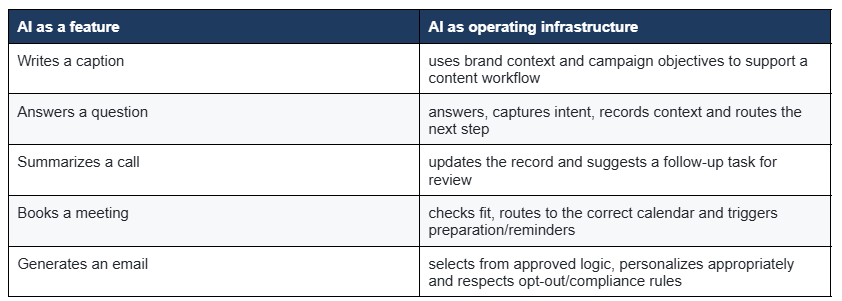
AI is now moving through the same maturity curve that previous business technologies followed: novelty, experimentation, integration and eventually invisibility. The important development in 2026 is not that agents can generate listing descriptions or social captions. It is that AI is becoming capable of participating in multistep workflows.
NAR's 2026 technology coverage describes this shift directly. In July, NAR Tech & Innovation argued that AI is moving from experiment to infrastructure and that the organizations gaining ground are integrating AI into daily operations with appropriate data, governance and security. [7] A June NAR article on agentic AI noted that systems can now be configured to draft and send messages, update CRM records, schedule follow-ups and trigger workflows with less direct human intervention. [10]
That is strategically different from using a chatbot as a writing assistant. Once AI can act, the quality of the operating system matters even more. An AI agent that is connected to messy data or unclear rules does not remove the problem; it accelerates it. An AI receptionist without escalation logic can create a poor client experience. An AI follow-up system without suppression rules can send messages at the wrong time. An AI research assistant without verification can confidently produce incorrect information.
The opportunity is therefore orchestration, not autonomy for its own sake. AI is well suited to repetitive, time-sensitive and context-heavy administrative work: acknowledging inquiries, collecting basic information, summarizing conversations, suggesting next actions, preparing appointment context and re-engaging dormant contacts under carefully designed rules. Human professionals remain essential where judgment, negotiation, ethics, empathy, local knowledge, fair housing considerations and fiduciary responsibility matter.
The adoption data already points to this distinction. NAR's 2025 Technology Survey found substantial AI usage but mixed business impact. [1] In February 2026, an RPR survey cited by NAR found that 92% of surveyed agents were using AI or planning to, 68% said AI saved them at least one hour per week, and 63% named accuracy of outputs as their top concern. [6] The market is clearly past the question of whether AI exists. The serious question is where it can be trusted, measured and supervised.
Broader business research tells the same story. McKinsey reported in its 2025 State of AI research that 71% of respondents said their organizations regularly used generative AI in at least one business function, with marketing and sales among the most common areas. Yet the report also found that relatively few organizations had mature scaling practices or KPI tracking around generative AI. [9] Adoption is widespread; disciplined value capture is not.
HUMAN-IN-THE-LOOP RULE
The more consequential the decision, the stronger the case for human review. AI can increase speed and consistency; it should not be allowed to quietly redefine legal, ethical, financial or client-service standards.
9. Measurement: The KPIs That Reveal Whether the System Is Working
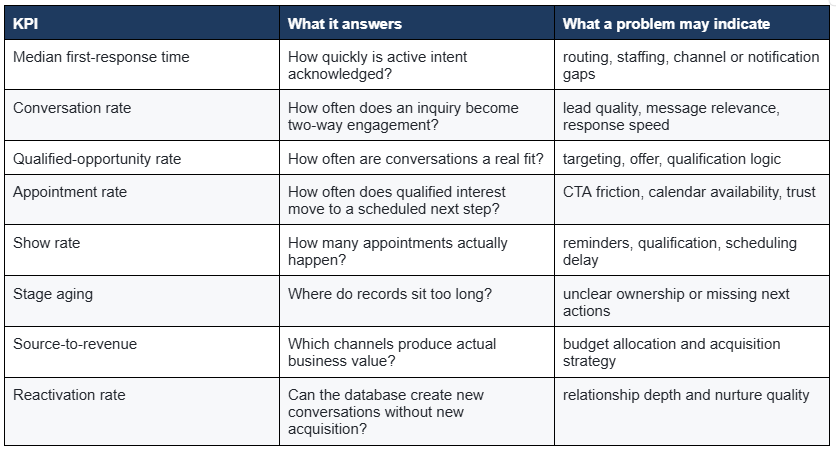
A growth system becomes useful when it can be measured. The objective is not to create a dashboard full of numbers; it is to expose the few transitions that determine whether marketing activity becomes business value.
Lead volume is an input. It should be tracked, but it is not sufficient. A source that generates 300 low-intent inquiries may be less valuable than a source that generates 40 conversations with serious buyers or sellers. The operating system should therefore measure movement: inquiry to response, response to conversation, conversation to qualified opportunity, qualified opportunity to appointment, appointment to show, show to client, client to transaction and transaction to referral or repeat business.
Speed-to-lead can be useful, but it should be interpreted as a service metric rather than a vanity race. The important question is whether the business consistently acknowledges active intent and creates a useful next step. Follow-up consistency can be measured by how many opportunities receive the intended cadence rather than by how many messages the system sends. Pipeline leakage should identify the stage where opportunities disproportionately disappear. Revenue attribution should connect closed business back to source, campaign and relationship history whenever possible.
The best KPI system also reveals capacity. If response time rises sharply when lead volume crosses a threshold, the business has found an operational limit. If appointment volume increases but show rate falls, qualification or reminder quality may be weak. If show rate is strong but client conversion is poor, the problem may sit in consultation quality, market fit, pricing or sales process. Metrics should point to the constraint rather than flatter the business.
10. A Practical 90-Day Operating Roadmap
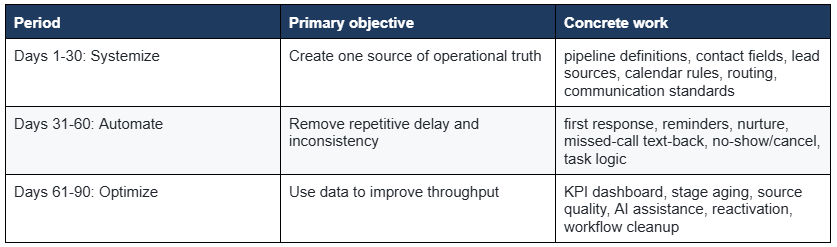
A growth system does not need to be built all at once. In fact, attempting to automate everything before the business has clarified its processes is one of the fastest ways to create complexity. A better sequence is to make the customer journey visible, standardize the important transitions, automate the repetitive portions and then optimize from real performance data.
The first thirty days should focus on structure. Define the primary lead sources, pipeline stages, ownership rules, calendars, qualification questions and minimum data required on a contact record. Decide which communication channels are official. Remove obvious duplication. Make sure opt-in, consent and suppression logic are understood before automations are expanded.
Days thirty-one through sixty are where repetitive work becomes workflow. Build immediate acknowledgments, task creation, appointment reminders, no-show handling, nurture logic, missed-call response and reactivation for selected segments. Keep each workflow narrow enough that the team can explain why it exists. Automation should make the process easier to understand, not harder.
Days sixty-one through ninety should focus on intelligence and refinement. Measure response time, conversation rate, appointment rate, show rate and stage aging. Review where humans are overriding the automation and why. Train AI only where there is reliable context, clear boundaries and a measurable benefit. Then improve the constraint that is actually limiting throughput rather than adding features for their own sake.
11. Strategic Outlook: 2026 to 2037
IMPORTANT
The following section is a scenario-based strategic outlook built from current adoption patterns. It is not a claim that specific technologies, regulations or consumer behaviors will unfold on an exact timetable.
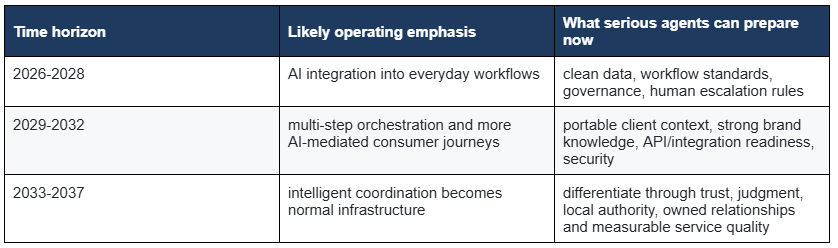
The direction of travel is clearer than the calendar. Real estate is moving toward a market in which digital discovery, AI assistance, instant information and human advisory work are tightly intertwined. By 2026, that transition is already visible: AI is part of daily agent workflows, buyers are beginning to use AI for home research, and industry bodies are discussing agentic systems, governance and generative-engine visibility. [6][8][10][12]
Between 2026 and roughly 2028, the most important shift is likely to be integration. The market will move away from standalone AI novelty and toward AI embedded inside CRMs, portals, transaction platforms, search experiences and communication tools. The differentiation will not be access to a model. It will be the quality of the data, workflows and controls surrounding it. This is consistent with NAR's 2026 description of AI moving from experiment to infrastructure. [7]
The second phase, which could dominate the late 2020s and early 2030s, is orchestration. Consumers may increasingly expect one continuous experience across search, financing education, property questions, scheduling and agent communication. Internal operations may become more agentic as systems handle routine coordination across several tools. At the same time, regulation, disclosure, security, fair housing and consent requirements are likely to become more explicit because the cost of automated mistakes rises as systems gain autonomy.
A third shift is likely to be the rise of AI-mediated discovery. NAR reported in 2026 that consumers are already asking generative systems who the best agents are in a market and highlighted Generative Engine Optimization as an emerging visibility discipline. [12] If that behavior continues, brand authority will need to be legible not only to search engines and social platforms but also to AI systems that synthesize recommendations from public information. Structured expertise, credible content, consistent profiles, local evidence and strong reviews may become even more important.
By the middle of the 2030s, the most durable distinction may be between businesses that merely use automation and businesses designed around intelligent coordination. The latter will have cleaner data, fewer handoffs, clearer service standards and better instrumentation. A solo operator with disciplined systems may have access to capabilities that once required administrative staff, a marketing coordinator and a large brokerage technology stack. That does not mean the solo agent becomes a machine. It means the machine absorbs more of the coordination so the professional can spend a greater share of time on judgment, negotiation and trust.
The human relationship is therefore unlikely to become less valuable. Current research suggests the opposite: even as the digital journey expands, agent usage remains high. [2][4] The professional advantage may shift toward the parts of the work that are difficult to commoditize - local interpretation, emotional intelligence, negotiation, risk assessment, ethical judgment, advocacy and the ability to help a client make a consequential decision with confidence.
The practical 2037 question is not whether agents will have AI. If current trends hold, AI will be ordinary infrastructure. The better question is whether the business has been engineered so that technology compounds trust rather than erodes it.
12. The Realty Excellence Framework: Systemize, Scale, Stand Out, Sustain
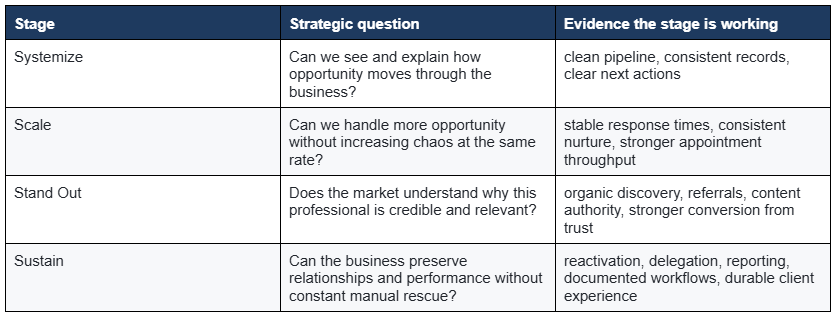
Realty Excellence is built around the idea that growth becomes more durable when the business develops in the right order. The internal framework is Systemize, Scale, Stand Out and Sustain: build the structure first, increase capacity second, strengthen authority third, and design the business so performance does not depend on permanent firefighting. This positioning is consistent across the Realty Excellence brand and sales academy materials. [RE]
Systemize is the foundation. Leads, conversations, calendars and pipeline stages need one coherent structure. The goal is not to automate everything; it is to make the business understandable. When the owner can see where opportunities are, what each stage means and what happens next, automation has something reliable to support.
Scale is the capacity layer. Once the process is visible, automation and AI can reduce response lag, maintain nurture, support appointment flow and remove repetitive administration. Scale is not simply adding more leads. It is increasing the amount of opportunity the business can handle without lowering the quality of the client experience.
Stand Out is the authority layer. As AI makes generic content and basic automation easier to access, trust becomes more important. Buyers and sellers still need professionals who can interpret local conditions, explain trade-offs and guide decisions. Brand, content, reviews, community presence and a consistent client experience help turn operational competence into market authority.
Sustain is the long-term layer. A mature business should not collapse when the owner takes a day away from the inbox, when an ad campaign pauses or when one staff member leaves. It should have documented processes, long-term nurture, reporting, delegation and reactivation systems that preserve relationships over time. The goal is not a business with no human involvement. It is a business in which human involvement is spent where it creates the most value.
REALTY EXCELLENCE POSITION
Realty Excellence is designed as a real-estate-specific operating ecosystem rather than a generic CRM: CRM and pipeline structure, AI-assisted communication, follow-up, appointment systems, reporting, onboarding and brand infrastructure are organized around one client journey. The system supports the relationship; the agent remains responsible for professional judgment, appointments, negotiation and closing.
13. Frequently Asked Questions
What is a real estate growth system?
It is the connected structure that governs how a real estate business attracts, captures, responds to, qualifies, nurtures, schedules, serves and measures opportunities. Software is part of the system, but the system also includes process, standards, ownership and measurement.
Is a CRM enough to build predictable growth?
A CRM is usually necessary for visibility, but it is not sufficient by itself. Predictability comes from the workflows, definitions, communication standards, automation and reporting built around the CRM.
Do agents still need more leads?
Some do. The important question is where the current constraint sits. If the pipeline is genuinely underfilled, acquisition deserves attention. If inquiries are already aging, follow-up is inconsistent or appointment capacity is weak, adding more leads may magnify the problem instead of solving it.
How fast should a real estate lead be contacted?
There is no universal transaction-specific number that guarantees conversion. Research on online sales leads shows that faster response improves the probability of meaningful engagement, while current real estate research shows many consumers prefer digital communication. The practical standard is to acknowledge active intent quickly, preserve context and create a useful next step.
What should an agent automate first?
Begin with repetitive, rules-based work that is easy to audit: inquiry acknowledgment, task creation, appointment confirmations, reminders, no-show/cancel handling, missed-call response and selected nurture. Avoid automating complex judgment before the process is clear.
Will AI replace real estate agents?
Current evidence supports a more nuanced view. AI is taking on administrative, analytical and communication tasks, while buyers and sellers continue to use agents at high rates. The likely advantage is human professionals using AI to improve speed and capacity while remaining responsible for judgment, negotiation, ethics and relationships.
What is agentic AI in real estate?
Agentic AI refers to systems that can take actions across workflows rather than simply generate answers. Examples include updating CRM records, scheduling follow-ups, routing leads and triggering tasks. Because these systems act, governance and human oversight become more important.
Why does content matter to an operating system?
Content is part of acquisition and trust. Zillow found that online channels play a meaningful role in how buyers and sellers find agents, and 2026 NAR coverage notes that AI systems are becoming another pathway through which consumers research professionals. Strong, useful content helps both people and digital systems understand an agent's expertise.
What should a team measure first?
Start with median response time, conversation rate, qualified-opportunity rate, appointment rate, show rate, stage aging and source-to-revenue. These metrics reveal whether the system is actually moving opportunity rather than simply producing activity.
How long does it take to build a real estate operating system?
A useful foundation can be established in roughly 30 days if scope is controlled. A fuller system should be treated as an ongoing operating discipline: structure first, automation second, optimization third.
Conclusion: Predictability Is an Operating Achievement
The real estate business of 2026 is not short of technology. The challenge is turning technology into coordinated behavior. Consumers are digital, but they still value agents. AI is widespread, but measurable impact is uneven. Lead generation is scalable, but attention is perishable. CRMs can hold enormous amounts of information, but information creates little value when the business has not defined what happens next.
Predictable growth therefore comes from something less glamorous and more durable than a new feature: operating clarity. The business knows how opportunity enters, how it is acknowledged, how context is preserved, how the next step is chosen, how long-term relationships are maintained and how performance is measured. Once those pieces are clear, technology can do what it is best at - reduce friction, increase capacity and make consistency easier.
That is also why the future of real estate should not be framed as a contest between agents and machines. The more useful distinction is between businesses that remain dependent on scattered effort and businesses that deliberately engineer how work moves. The technology will keep changing. The discipline of building a clear system will remain.
The question is no longer only, “How many leads can we generate?” It is, “How much opportunity can our business handle well?”
EXPLORE REALTY EXCELLENCE
Realty Excellence helps real estate professionals build the structure behind modern growth - from CRM and pipeline architecture to AI-assisted follow-up, appointment systems, reporting, onboarding and long-term nurture. Explore the system at realtyexcellence.ai.
Key Takeaways
• The modern real estate challenge is no longer simply access to leads. It is the ability to turn fragmented attention into a consistent client journey.
• Digital behavior has made the agent relationship more, not less, important: Zillow reports that 84% of recent buyers used an agent, while NAR reports 88% of buyers purchased through an agent or broker in its 2025 survey population. [2][4]
• Speed and channel fit matter. Zillow found that 50% of buyers who used an agent preferred texting or messaging apps, compared with 33% who preferred phone calls. [3]
• AI adoption is moving quickly, but adoption alone is not performance. In NAR's 2025 Technology Survey, 42% of REALTORS® said they used AI daily or weekly, yet 46% said AI had no noticeable business impact. [1]
• The stronger long-term advantage is integration: workflows, clean data, clear ownership, thoughtful automation and human judgment working together.
Research References & Methodology Notes
[1] National Association of REALTORS® — 2025 REALTOR® Technology Survey
https://www.nar.realtor/research-and-statistics/research-reports/realtor-technology-survey
Used for technology adoption, AI usage, client response to technology and lead-generating technology findings.
[2] Zillow Research — Buyers: Consumer Housing Trends Report 2025
https://www.zillow.com/research/buyers-housing-trends-report-2025-35688/
Used for buyer-agent usage, first-step behavior, app adoption and agent discovery channels.
[3] Zillow — Consumer Housing Trends Report for Agents: What Buyers & Sellers Want From Real Estate Agents
https://www.zillow.com/agents/2025-consumer-trends-report/
Used for buyer communication preferences and agent-facing consumer insights.
[4] National Association of REALTORS® — 2025 Profile of Home Buyers and Sellers
https://www.nar.realtor/research-and-statistics/research-reports/highlights-from-the-profile-of-home-buyers-and-sellers
Used for buyer/seller use of agents and broader transaction context.
[5] Harvard Business Review — The Short Life of Online Sales Leads (2011)
https://hbr.org/2011/03/the-short-life-of-online-sales-leads
Historical cross-industry lead-response study. Not real-estate-specific; used with explicit caveat.
[6] NAR REALTOR® News / Realtors Property Resource — You’ve Tried AI, But Can You Trust It? (Feb. 12, 2026)
https://www.nar.realtor/news/real-estate-news/technology/youve-tried-ai-but-can-you-trust-it
Used for 2026 agent AI adoption, time savings and accuracy concerns.
[7] NAR Tech & Innovation — 5 AI Trends Changing Real Estate Right Now (July 16, 2026)
https://tech.realtor/2026/07/16/5-ai-trends-changing-real-estate-right-now/
Used for the shift from AI experiment to infrastructure and the emphasis on integration, governance and security.
[8] NAR Tech & Innovation — AI Becomes Early Step in Homebuying Journey (July 14, 2026)
https://tech.realtor/2026/07/14/ai-becomes-early-step-in-homebuying-journey/
Used for the finding that 20% of prospective buyers/current homeowners had used AI/chatbots for homebuying research.
[9] McKinsey & Company — The State of AI: How Organizations Are Rewiring to Capture Value (2025)
https://www.mckinsey.com/capabilities/quantumblack/our-insights/the-state-of-ai
Used for broader business AI adoption and the gap between adoption and mature scaling/KPI practices.
[10] NAR REALTOR® News — AI’s Current Iteration Poses Higher Risk—and Reward—for Brokers (June 16, 2026)
https://www.nar.realtor/news/broker-news/ais-current-iteration-poses-higher-risk-and-reward-for-brokers
Used for agentic AI examples such as CRM updates, follow-ups and workflow triggers.
[11] Zillow Research — Prospective Buyers: Consumer Housing Trends Report 2025
https://www.zillow.com/research/prospective-buyers-consumer-housing-trends-2025-35888/
Used for communication preferences and prospective-buyer digital behavior.
[12] NAR REALTOR® News — Find Your GEO to Land Your Next Referral From AI (May 18, 2026)
https://www.nar.realtor/news/real-estate-news/technology/find-your-geo-to-land-your-next-referral-from-ai
Used for the emerging role of Generative Engine Optimization and AI-mediated professional discovery.
[RE] Realty Excellence internal brand and Sales Academy materials
Used for the Systemize → Scale → Stand Out → Sustain framework and the positioning of Realty Excellence as a real-estate-specific operating ecosystem rather than a generic CRM.
METHODOLOGY NOTE
Statistics from different surveys should not be treated as directly interchangeable. Zillow, NAR, RPR and McKinsey use different populations, question wording, field dates and methodologies. Where two sources address a similar topic, this guide uses them as complementary evidence rather than averaging them into a single number.


